

Casey Brown: Climate Change Is Water Change

SHARE


We should be worried.
The climate is changing, disrupting weather patterns and events leading to unpredictable water availability. This is a subject that has been on my mind for a while now and I had to get someone's opinion on it. And who better than a PowWater Advisor and Professor of Water with a PhD from Harvard University. I spoke with Casey Brown - widely regarded as one of the leading water experts globally - to ask some key questions on climate change and its effects.
Q: Who is Casey Brown? Why Water?
A: I am a Provost Professor of Water Resources Engineering at the University of Massachusetts Amherst. I work on water because I like to work on important things that need solutions, to work where I can make a difference. Water touches people, the environment, it's a key variable supporting civilization, so it's always interesting.
Q: How has climate change affected water? The good and the bad.
A: Climate change has some positives in that it's making people think about the future, the long term, in a more serious way. The truth is that the climate has always been variable and the industry hasn't fully adapted to present variability. Climate change is an amplifier of the same problems the industry has always grappled with.
Q: Climate change manifests itself primarily through changes in the water cycle. The climate is warming, and a few degrees can drastically change extreme weather events. How can we humans adapt to change for our survival?
A: There's a need for some innovation but for the most part the real challenge is the adoption of innovation. There are lots of great ideas and technologies that could greatly reduce the anticipated impacts of climate change. But right now the industry and people aren't willing to pay for them. We need more receptiveness to innovation in the water sector, especially with public regulators. There needs to be funding to pay for adoption of the new technologies that can solve these problems. The greatest challenge for climate adaptation is having the political will to make the changes that need to be made.
Q: What are the sustainable, affordable and scalable water solutions?
A: There's a long list. But a few broad categories include really exciting new irrigation equipment, financial instruments that can transform climate risk into insurable financial risk, hydrologic forecasting, and new ways to reach people who will never have access to piped water networks like PowWater.
Q: What is the way forward? What must be done by the private sector?
A: I'm increasingly convinced we need more private sector involvement, to fund the needed innovations, to develop innovations, and to better manage risks. And that's where PowWater comes in.
Q: Final thoughts?
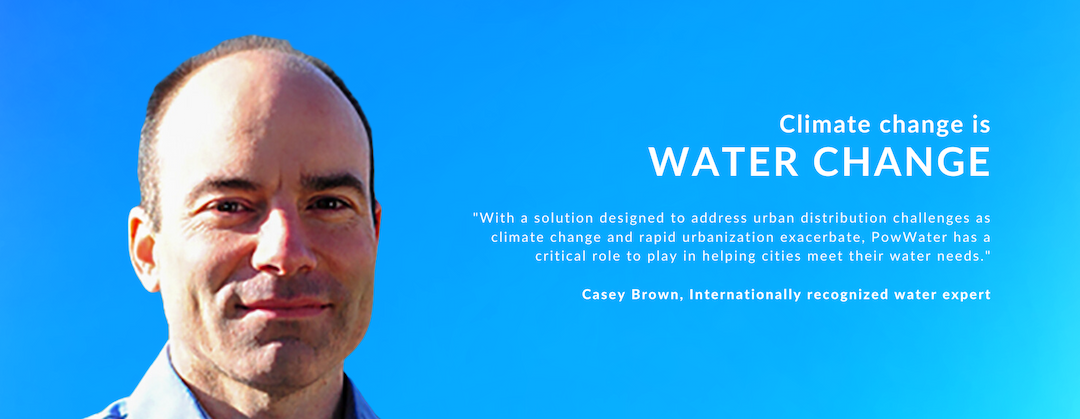
A: There's a lot of opportunity to do a lot of good right now. All the attention is on carbon mitigation, but water challenges are how climate change affects people, and people are affected right now. We can solve these challenges if we can find a pathway for the adoption of the innovations that exist now. With a solution designed to address urban distribution challenges as climate change and rapid urbanization exacerbate, PowWater has a critical role to play in helping cities meet their water needs. I am excited about the future of PowWater!
And that's it, folks! What are your thoughts on the ongoing climate change? Stay watered!
Pow
Casey Brown: Climate Change Is Water Change
Published on: June 9, 2023
We should be worried.
The climate is changing, disrupting weather patterns and events leading to unpredictable water availability. This is a subject that has been on my mind for a while now and I had to get someone's opinion on it. And who better than a PowWater Advisor and Professor of Water with a PhD from Harvard University. I spoke with Casey Brown - widely regarded as one of the leading water experts globally - to ask some key questions on climate change and its effects.
Q: Who is Casey Brown? Why Water?
A: I am a Provost Professor of Water Resources Engineering at the University of Massachusetts Amherst. I work on water because I like to work on important things that need solutions, to work where I can make a difference. Water touches people, the environment, it's a key variable supporting civilization, so it's always interesting.
Q: How has climate change affected water? The good and the bad.
A: Climate change has some positives in that it's making people think about the future, the long term, in a more serious way. The truth is that the climate has always been variable and the industry hasn't fully adapted to present variability. Climate change is an amplifier of the same problems the industry has always grappled with.
Q: Climate change manifests itself primarily through changes in the water cycle. The climate is warming, and a few degrees can drastically change extreme weather events. How can we humans adapt to change for our survival?
A: There's a need for some innovation but for the most part the real challenge is the adoption of innovation. There are lots of great ideas and technologies that could greatly reduce the anticipated impacts of climate change. But right now the industry and people aren't willing to pay for them. We need more receptiveness to innovation in the water sector, especially with public regulators. There needs to be funding to pay for adoption of the new technologies that can solve these problems. The greatest challenge for climate adaptation is having the political will to make the changes that need to be made.
Q: What are the sustainable, affordable and scalable water solutions?
A: There's a long list. But a few broad categories include really exciting new irrigation equipment, financial instruments that can transform climate risk into insurable financial risk, hydrologic forecasting, and new ways to reach people who will never have access to piped water networks like PowWater.
Q: What is the way forward? What must be done by the private sector?
A: I'm increasingly convinced we need more private sector involvement, to fund the needed innovations, to develop innovations, and to better manage risks. And that's where PowWater comes in.
Q: Final thoughts?
A: There's a lot of opportunity to do a lot of good right now. All the attention is on carbon mitigation, but water challenges are how climate change affects people, and people are affected right now. We can solve these challenges if we can find a pathway for the adoption of the innovations that exist now. With a solution designed to address urban distribution challenges as climate change and rapid urbanization exacerbate, PowWater has a critical role to play in helping cities meet their water needs. I am excited about the future of PowWater!
And that's it, folks! What are your thoughts on the ongoing climate change? Stay watered!
Pow
Kenya's #1 clean water delivery
PowWater, 2026.
Get the app





© 2020 - 2026 PowWater